

In rural and remote areas there are now choices of connectivity technologies, however it can be complex to find out what is available, which providers sell these technologies and what plans and equipment best suit your needs.
How to find out what broadband technologies you can access at your specific address:
- NBN TECHNOLOGIES – nbn fixed line, nbn fixed wireless & nbn Satellite Every Australian residence is mapped for NBN (except in certain areas that are serviced by alternate fibre providers, e.g. OptiComm). You can’t choose your access technology, but you can choose your provider. Each residence is entitled to its own NBN connection, even if you have multiple dwellings on your property.
- To find out what nbn technology you can access, you can put your address into the nbn rollout map – here The map will pin your location and tell you what nbn technology you are mapped for, if you click on more information you can access a list of providers who sell that specific technology. NB: Not all providers sell all nbn technology types, and some providers don’t sell high speed tiers. nbn Sky Muster satellite services will be migrated to Amazon’s Project Kuiper Leo Satellite services in mid 2026.
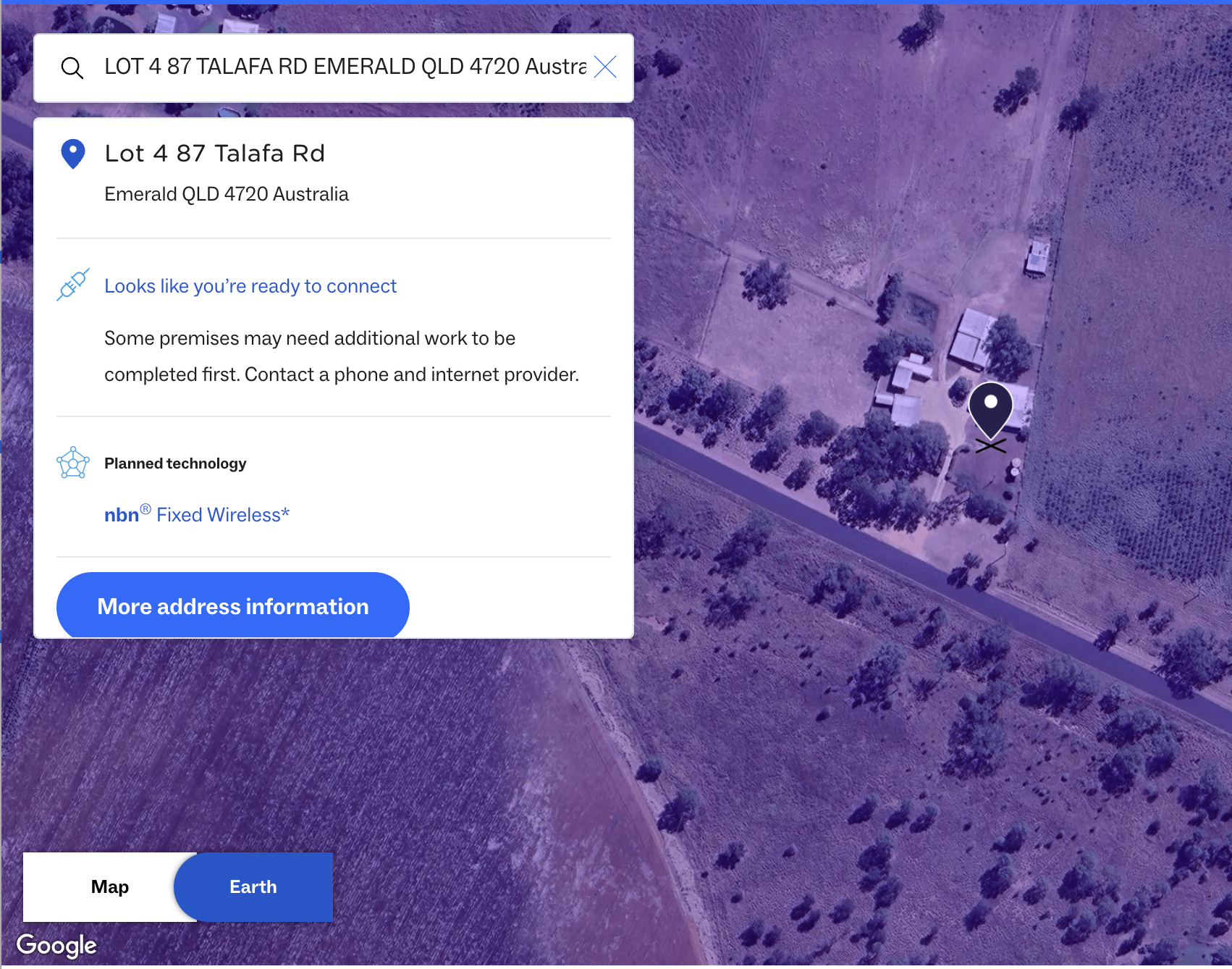
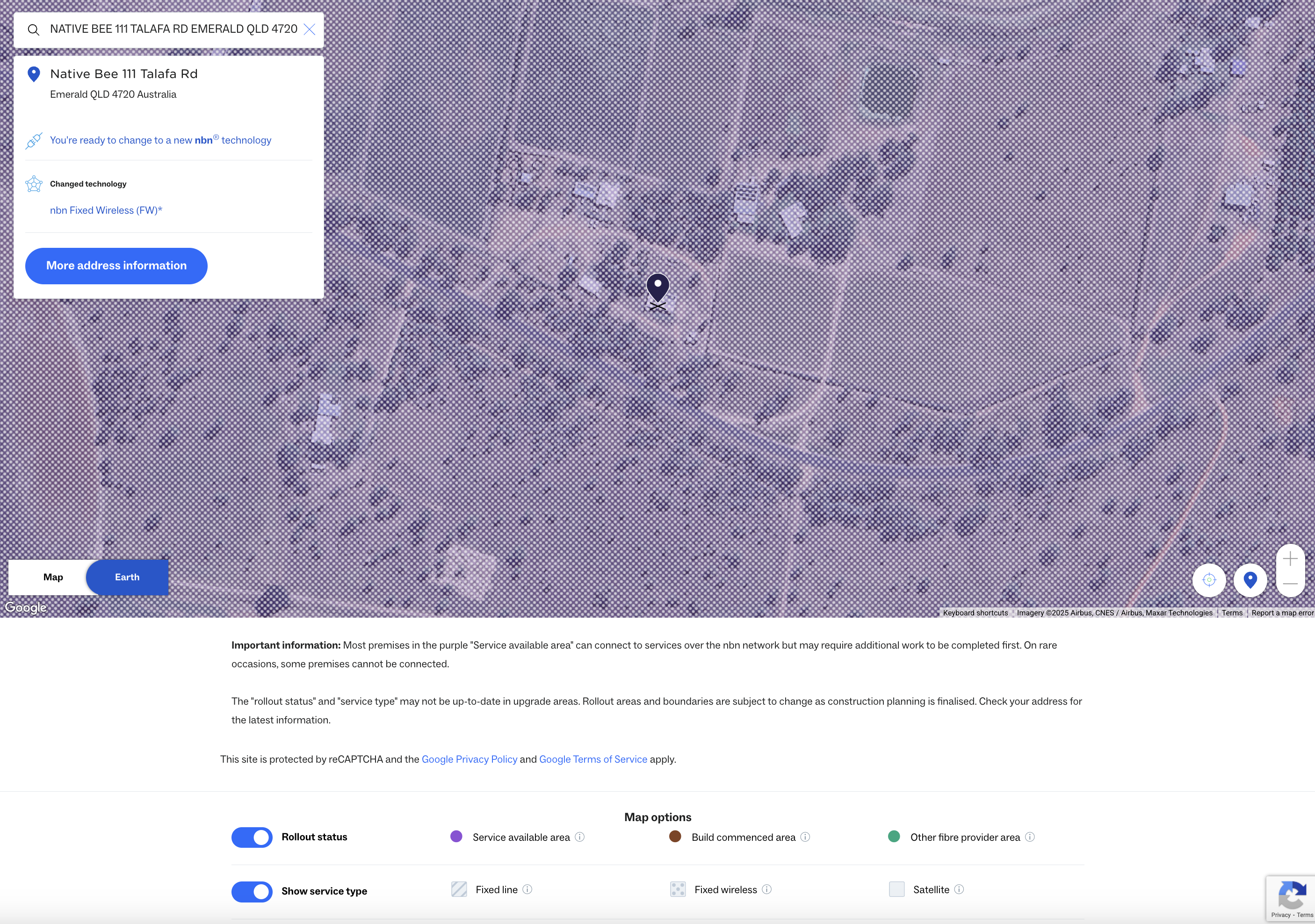
If your address doesn’t map, maps incorrectly or it’s a new house or an additional house on a property, you may need to get a new LOCID (nbn location identifier) or get the existing LOCID edited. The Regional Tech Hub can assist with this, they are a free and independent service. They can also assist if the nbn maps show that the location now has nbn Fixed Wireless coverage, but your address is still mapped for nbn Satellite. To check this you can ‘toggle on’ service type on the nbn roll out map – if your house or business is close to or covered by the ‘shaded dots’ you can ask the Regional Tech Hub to check with nbn if you would be eligible for nbn Fixed Wireless.
2. WISPs – Wireless Internet Service Providers
WISPs are alternate to nbn fixed wireless internet service providers. they operate in many rural and regional areas. BIRRR has a map of existing WISP towers which you can view here

This map is intended only as a very rough guide as to what may be available in your area, and is not intended to show precise coverage information. Please refer to the website or contact details of any WISP linked to our map to determine if they can service your premises.
Note: BIRRR has gathered the information above from providers, which we understand to be true and correct at time of publishing. This does not equate to any form of endorsement. Please thoroughly investigate your options before deciding on the best provider for you.
When mapping WISPs, BIRRR looks into if a WISP has a carrier licence and is a member of the TIO scheme. Under rules contained in the Telecommunications (Consumer Protection and Service Standards) Act 1999 WISPs need to have:
- a carrier license – you can check a WISP has a carrier license on ACMAs register here
- be a member of the TIO scheme
3. Starlink – Leo Satellite Service
Starlink is a Low Earth Orbit Satellite Service providing services across Australia, there are a variety of plans and offerings, including roaming plans and fixed broadband plans. You can view the availability map here:
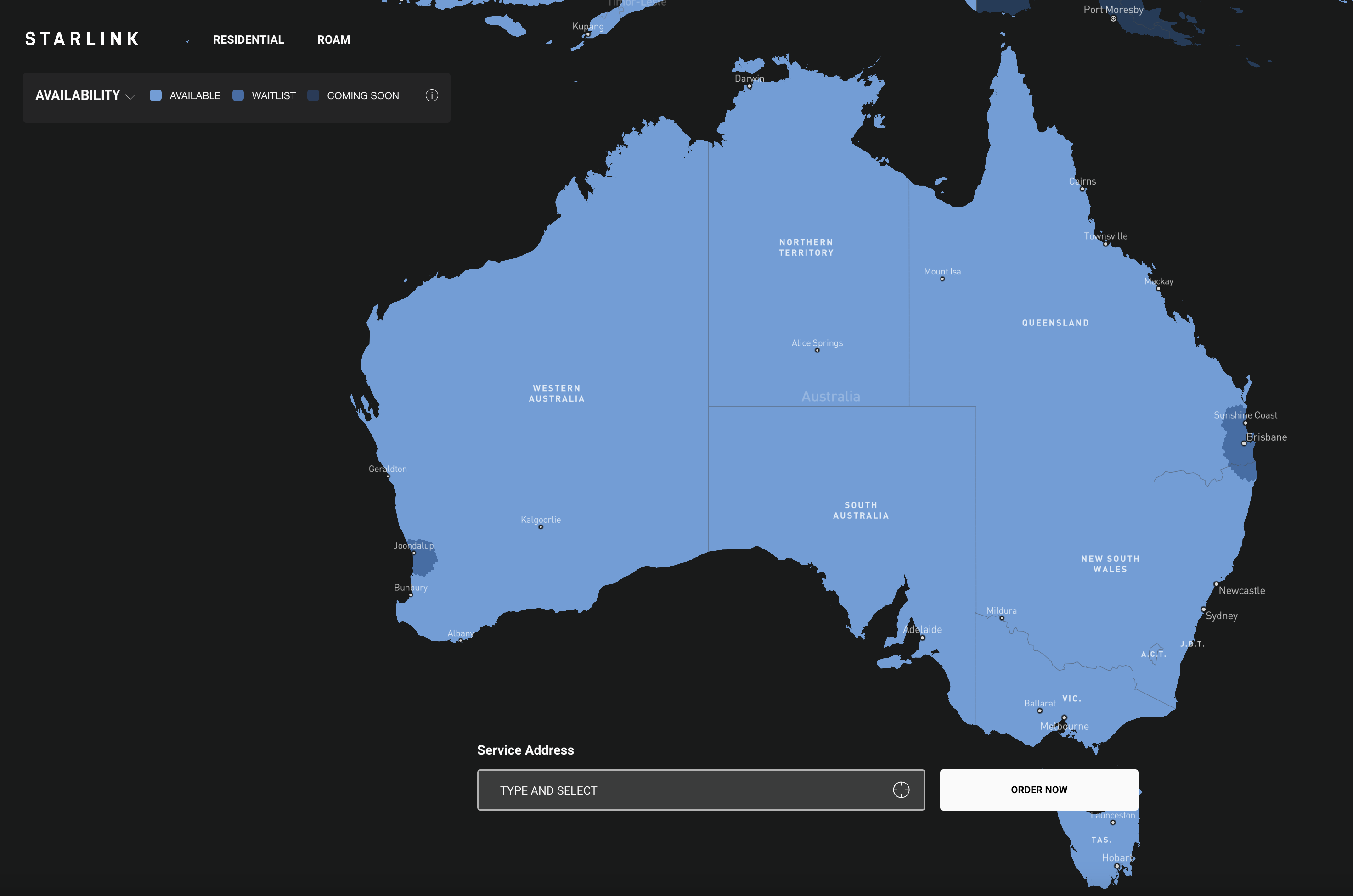
Note: There are some areas of Australia that are currently subject to a demand surcharge of between $145 and up to $1295 for residential plans.
As Starlink is a satellite service and a foreign owned entity there are some considerations for using this technology, BIRRR has put together an Obstacles and Opportunities info sheet which can be accessed here
Starlink generally has a higher latency, slower speeds, higher packet loss and is more expensive than fixed terrestrial infrastructure such as fibre and fixed wireless.
Starlink equipment is also available from numerous retailers across Australia including Officeworks, Harvey Norman & JB Hi-Fi, as well as through the Telstra Home Satellite Service.
4. Alternate Fibre, ADSL & Cable
There are several alternate to nbn fibre companies provider services in regional areas.
Opticomm – offering services in some regional cities such as Rockhampton, Bundaberg and a NSW Government funded project to deliver fibre to Gulargambone and Menindee, NSW
Taipan Networx – offering services in Winton & Yeppoon, QLD areas
Telstra ADSL – ADSL/DSL is an aging broadband technology that uses copper lines to deliver voice and broadband services. Although some rural and remote consumers are still connected via ADSL it is being replaced by newer broadband connection options and Telstra are no longer taking new orders for ADSL services.
5. Mobile Broadband
There are three mobile carriers in Australia -you can check out their coverage maps below.
Optus: www.optus.com.au/living-network/coverage
Vodafone: www.vodafone.com.au/network/coverage-checker
Telstra – note the step by step details below as Telstra’s coverage maps need some guidance.
 Visit the Telstra Coverage Maps here: http://www.telstra.com.au/coverage-networks/our-coverage Use this website to Find your coordinates , write them down or email them to yourself.
 Enter your coordinates or address in the search bar, then click “Search.”
 You’ll see a map showing coverage at your location. Look for handheld coverage – it’s green for 4G and purple for 5G, white means NO HANDHELD COVERAGE. Take a screenshot of the image (handheld coverage).
 Zoom out (click the “minus” button) and select “Maximise Your Signal” to check for antenna coverage. Take a screenshot of the image (antenna coverage). NB: Once you zoom out the marker disappears, but your location usually stays in the middle of the map.
INSERT BIRRR TECH COMPARISON INFOGRAPHIC HERE (Coming soon)
The Regional Tech Hub has a video to help you choose the right technology.
The Regional Tech Hub also has some tips on factors you should consider when choosing a provider. You can view them here
 Better Internet for Rural, Regional & Remote Australia (BIRRR)