
A new possibility for connectivity when out of terrestrial mobile range.
What is DTH Technology
Direct-to-Handset (DTH) technology allows mobile phones to connect to ubiquitous baseline coverage using Low Earth Orbit (LEO) satellites, offering potential coverage in areas without traditional land-based mobile or Wi-Fi networks. DTH also has the potential to improve the availability of mobile services during disasters and power outages.
Direct to Handset (DTH), is also known as Direct to Device (DTD), Direct to Cell (DTC), or Satellite to Mobile (STM). While innovative, DTH technology is not a replacement for terrestrial mobile networks or fixed broadband, which provide significantly greater capacity, scalability, and reliability.
Telstra Satellite-to-Mobile (STM)
On the 15th May 2025 Telstra announced their Satellite-to-mobile messaging service would become available to some consumers – with compatible handsets and plans – in the coming months. On the 3rd June 2025 Telstra launched this service. The service uses Starlink Low Earth Orbit (LEO) satellites and requires outdoor line of sight to the sky, a compatible mobile handset, and active Telstra Upfront Mobile plan and Sim Card. It relies on the latest Starlink LEO satellites, in contrast, Starlink broadband residential and roaming services utilise the entire constellation of approximately 7,500 satellites.
Telstra states: “For eligible customers with a compatible handset, Telstra Satellite Messaging will be added to your core plan inclusions and you can start using this service as soon as it’s enabled….You will be able to send SMS messages via the Starlink Direct to Cell satellite network to standard Australian and International numbers, in most places throughout Australia when the mobile network is unavailable and you are outdoors with a direct line of sight to the sky.”
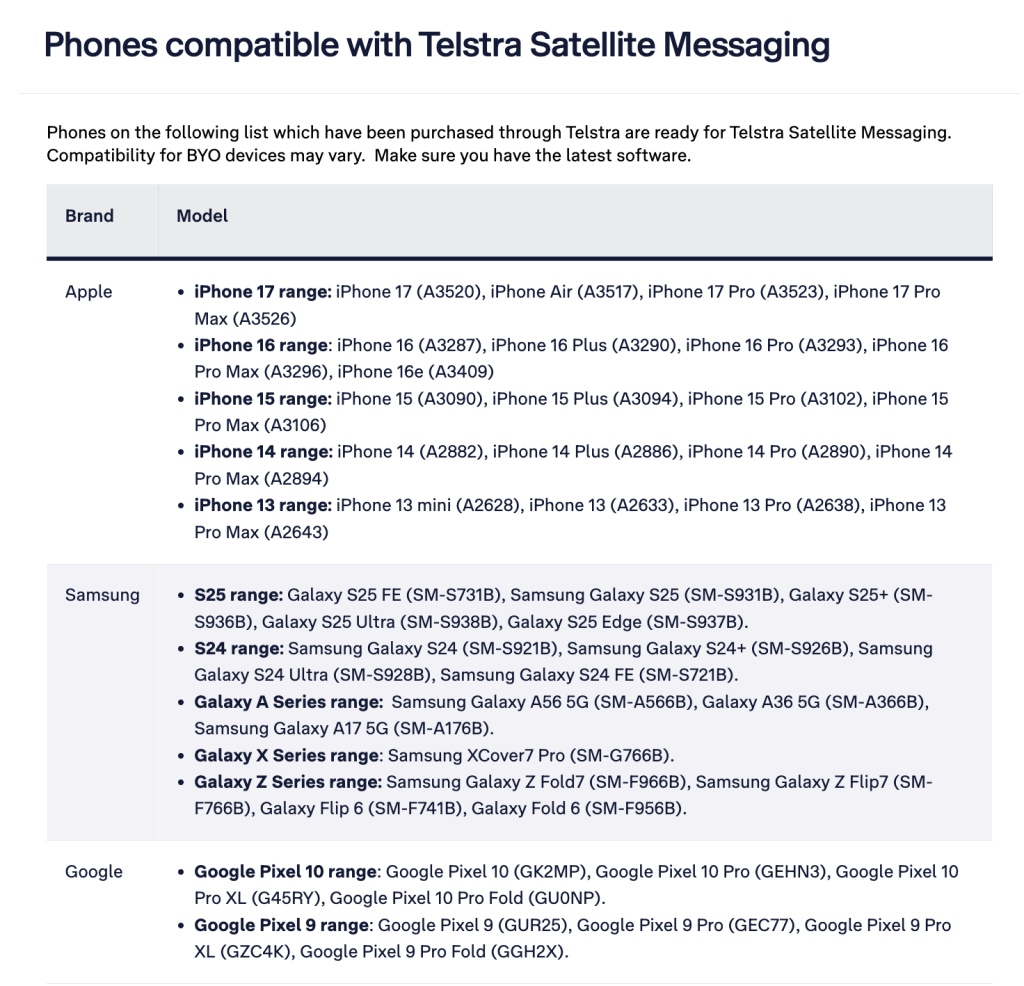
Further details of compatible devices and plans for Telstra’s satellite-to-mobile messaging can be found here
How to find your phone model
- iPhone: Go to settings > General > About. Then tap the model number to reveal your “A” number
- Samsung: Go to settings > About phone > Model name.
- Compatible Samsung model number must also include compatible “Service provider software version”: “TEL/TEL,TEL/XSA/TEL”, “XSA/XSA, XSA/XSA/XSA” or “XSA/-/XSA/”. To find this, go to Settings > About phone > Software information.

What You Need – Telstra STM
- A compatible device – see list above
- Up to date device software.
- An eligible Telstra plan – Consumer and Small Business Telstra Upfront Mobile Plans (i.e. not pre-paid), Telstra Enterprise customers on eligible Adaptive Mobility plans with the Satellite Message add-on
- For iphones – updated carrier settings. Go to settings > general > about > a service provider settings update pop up may occur – click update.
- A clear line of site to the sky – not be inside a vehicle or house or have any obstruction such as trees.
- Ensure you are sending text/emojis only – not photos or attachments.
- Patience – it can take up to 10 minutes, sometimes longer to send / receive an sms.
- The Telstra STM service displays like the image below on an iphone – note the bars are satellite signal strength NOT mobile service.

NB: Do not have aeroplane mode toggled on. There is no way to ‘force’ the device into satellite mode (even if you have unusable mobile coverage).
You can not sms emergency services in Australia. You can not make voice calls using this technology.
Only available in outdoor areas in mainland Australia and Tasmania, excluding radio quiet zones and remote offshore territories and islands of Australia.
Apple Satellite Messaging Service
Apple’s satellite messaging service is designed for emergencies only when you are outside mobile and Wi-Fi coverage. It allows users to send emergency messages to an emergency Apple contact centre, share your location through Find My iphone, and request roadside assistance, but it does not support general texting, voice calling or internet access. The service works on iPhone 14, 15, 16 and 17 series devices, provided the handset has a clear view of the sky. To use it, users must enable satellite features in their device settings, then follow on-screen prompts that guide them to point the phone toward a satellite to send messages or location updates.
You need:
- a compatible device
- the latest iphone update
- to be outdoors with line of sight to the sky
- to be outside mobile coverage, there is no way of forcing your device to use this feature.
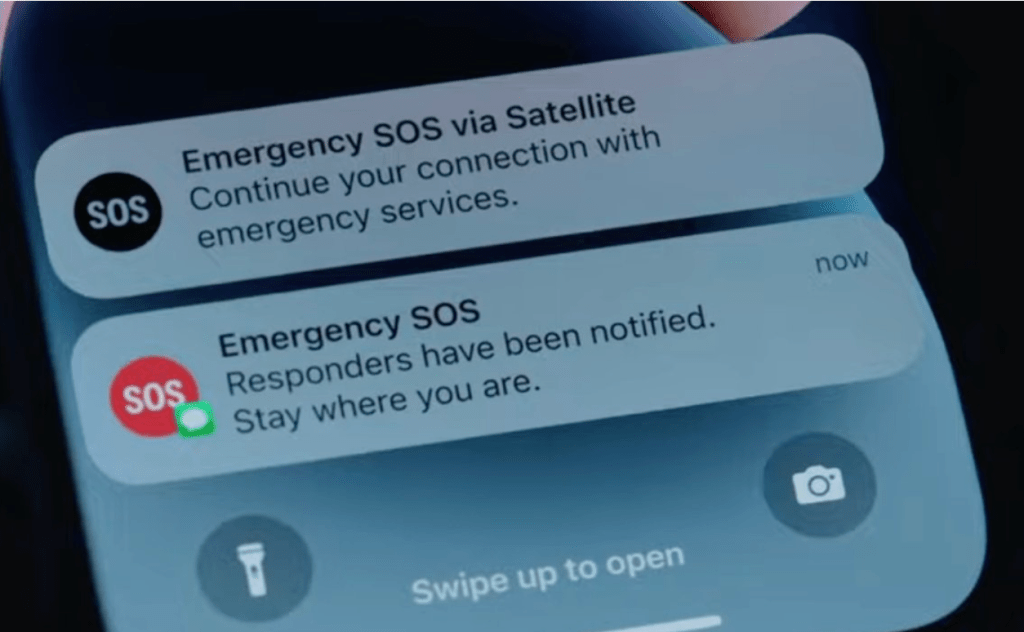
Use Emergency SOS via satellite on your iPhone
Use Roadside Assistance via satellite on your iPhone
Send your location via satellite in Find My on iPhone
How Does DTH Work?
DTH services use two main models:
- MSS (Mobile-Satellite Service):
- Works with smartphones that support mobile bands within MSS spectrum.
- Apple iPhone 14 and above / Globalstar network – Emergency SMS, Roadside Assistance & Find My iPhone tracking features are available in Australia on newer model iPhones running the latest iOS software.
- Google Pixel 9, Samsung S25 (Verizon)/ Skylo network – Emergency services on these handsets are currently available in the United States, with an expectation to be in Australia at some stage.
2. IMT (International Mobile Telecommunications):
- Works with standard modern 4G and 5G smartphones with Australian carrier support.
- Examples in Australia include Starlink with Optus and Telstra, Lynk Global and TPG (rollouts tba). NB: Telstra launched their satellite-to-mobile service in June 2025 for eligible customers with compatible handsets, latest software & on eligible plans.
What to Expect
- Line of Sight/Outdoors: A clear line of sight to the sky will be essential for a DTH connection. Trees, buildings, or weather may block signals.
- Only in areas without mobile coverage – there is no way to ‘force’ your phone into ‘satellite’ mode; it will automatically connect only when you are in areas with no mobile coverage.
- Initial Features: Services will focus on SMS/text messaging only—no photos, videos, or voice calls initially, with plans (no dates as yet) to roll out voice calls and low bandwidth data in the future. NB: Australia’s emergency services are not equipped for SMS messaging to Triple Zero.
- Delays: Message transmission times may vary, potentially taking several minutes, depending on your location, device, and the availability of Direct-to-Cell satellites.
- Coverage: Works only in areas without mobile coverage, even if the coverage you have is unusable.
- Battery: Device battery duration may be impacted due to the higher transit power required to use this technology
- Device Compatibility: Compatibility is expected restricted to specific newer mobile handsets
- Doesn’t support emergency broadcasting: DTH services do not currently support emergency broadcasting systems, meaning users will not receive critical emergency alerts such as bushfire warnings, flood updates, or other government-issued safety notifications.
- Teething Issues Anticipated: Consumers should be prepared for initial challenges during the rollout, including potential reliability issues caused by satellite handovers. It is unknown how Satellite Messaging will interact with or overpower the Apple SOS Satellite Emergency Service and vice versa.
The full extent of the limitations remains unclear due to the absence of real-world user experience data.
What You’ll Need
- For MSS: A specialised device/handset with satellite capabilities and an active SIM card.
- For IMT: A compatible smartphone, Australian carrier eligible plan, latest device software updates and active SIM card.
Australian Rollout Status
- Globalstar: In conjunction with Apple – Emergency SOS/Find My iPhone tracking/ Roadside Assistance is already available on iPhone 14+ in Australia, with the latest operating software. More information on how to use it on your iPhone is here
- Optus/Starlink: SMS/text services are expected in Australia in 2025 (subject to delays).
- Telstra/Starlink: Launched on 3rd June 2025 for Samsung Galaxy S25 series devices and 7th June for iPhone 13, iPhone 14, iPhone 15 and iPhone 16 (all models) on eligible plans and with updated software.
- Lynk Global: Previously partnered with Optus for testing purposes and have also announced a partnership with Telstra and TPG for upcoming trials. No rollout dates announced.
- Skylo / Garmin, Google and Samsung: Google have partnered with Skylo (a non-terrestrial network service provider) to launch an emergency messaging service. Skylo has partnered with Omnitouch, Skylo’s Mobile Virtual Network Operator (MVNO) test partner, to commence trials in Australia. When the Skylo MSS service is released in Australia, Google’s Pixel 9 is expected to provide a similar emergency SOS service to that of Apple. Whilst the Samsung S25 is also MSS capable; to date Samsung has not entered into a global agreement for MSS emergency SOS support and will require a local mobile service provider to enable such a service e.g. Verizon in the USA.
NB: At this time, Skylo’s satellite service partners appear to use GEO and not LEO networks. Whilst texting is fine with GEO, voice communications suffer degradation due to high latency.
- AST SpaceMobile is also developing a network of satellites that will directly connect to mobile phones. Optus announced an MoU with AST Space Mobile on 15 September 2022 to collaborate and test direct satellite to mobile technologies.
Important Considerations
- Commercial considerations: Pricing details are unclear at this stage, except for Apple’s Emergency SOS/ Find My iphone satellite features, which are currently free for two years with any new iphone purchase. It is uncertain what the cost will be following that two-year period, noting that Apple have recently extended the feature for iPhone 14 users. All types of DTH technology require the consumer to have an active mobile plan/number with an Australian mobile provider.
- Regulatory considerations: Specific regulatory requirements, particularly regarding emergency services, are yet to be finalised.
- Supplementary Nature: DTH complements existing terrestrial mobile or fixed networks, but will not replace them. High-speed services are unlikely.
- Environmental Factors: Coverage and performance depend on satellite availability and environmental conditions, such as weather or obstructions.
- Initial services: DTH will initially be SMS only, text messages (no photos or video attachments) – voice and low bandwidth data and ability to connect Narrowband Internet of Things (NB-IoT) devices are expected to be available in the future.
- DTH services in Australia will exclude Australian Radio Quiet Zone in Western Australia where no service is permitted to be provided and Remote Offshore Territories and Islands of Australia.
A Note of Caution
While DTH technology offers an exciting step forward in telecommunications in remote areas, it is not a silver bullet for rural and remote connectivity. DTH technology has the potential to deliver a baseline connectivity safety net and is not designed to replace fixed broadband. Until the technology has matured and developed, it is recommended consumers continue to consider alternate ways to stay connected when in areas without mobile coverage. BIRRR has this page for consumers on the move here and Telstra state: “Telstra Satellite Messaging is not designed to be an emergency service, especially as you cannot text Australian emergency responders (e.g. Triple Zero) directly. So, if you’re planning on visiting remote regions, it is always recommended to plan ahead and take extra precautions in the case of an emergency.“
It’s essential to recognise the limitations of this technology and important for operators and telecommunications providers to manage consumer expectations on what it will deliver.
Universal Outdoor Mobile Obligation (UOMO)
In February 2025, the current Federal Labor Government announced a commitment to introduce a Universal Outdoor Mobile Obligation (UOMO). If re-elected, the Government proposes to consult and introduce legislation in 2025 to expand the Universal Service Framework to incorporate mobile coverage for the first time. The Albanese Government’s policy objectives are to:
- expand Triple Zero access for Australians across the nation;
- expand outdoor voice and SMS coverage into existing mobile black spots; and
- improve the availability of mobile signals during disasters and power outages.
Implementation of outdoor SMS and voice will be expected by late 2027, with many Australians likely to obtain access before then. Basic mobile data will be considered in the future as technology roadmaps and capacity considerations develop. The Government will work with stakeholders and industry to get the legislation right, including flexibility where warranted by supply, spectrum and other factors. You can read the BIRRR Media release on the announcement here and our submission to the Draft UOMO Legislation here.
The Federal Government introduced Universal Outdoor Mobile Obligation (UOMO) legislation to Parliament on 27th November 2025. The legislation will require national mobile carriers Telstra, Optus and TPG to provide access to SMS and voice coverage for Australians nationwide, almost everywhere you can see the sky. You can read the announcement here
Updated 21/12/25, thanks to John Kitchener, Kristy Sparrow, Julie Stott, Ian Kelly , Telstra & Department of Infrastructure, Transport, Regional Development, Communications and the Arts
 Better Internet for Rural, Regional & Remote Australia (BIRRR)